How to Write a Seating Finish Schedule and FF&E Specification
How to write custom seating into an FF&E schedule and spec: item sheets, finish codes, COM fields, performance requirements and approvals, with a worked example.
Short answer: A good seating specification has three layers: an FF&E schedule line for each item (code, location, quantity, dimensions), a finish schedule that defines every material code once (fabric, leather, wood stain, metal, welt), and item spec sheets that bind them together with construction, performance and approval requirements. Write dimensions, materials and performance as requirements the manufacturer can price and verify, and require shop drawings and samples before production.
A banquette or chair that appears on a schedule as "Banquette, custom, upholstered, see elevation" will be priced five different ways by five bidders and built a sixth way. This guide explains how to specify custom seating so that what is quoted, drawn and delivered all match. It reflects how we at Spec Seating (a line by EASEN Commercial Furniture) read specifications when we price and draw.
Where does seating sit in the project documents?
Loose seating - chairs, stools, lounge pieces - is normally specified as FF&E on item-by-item spec sheets and an FF&E schedule, outside the contractor's project manual. Built-in banquettes and booths sit on the boundary: some teams treat them as FF&E supplied by the owner and installed by the contractor; others include them in the construction documents. In CSI MasterFormat, booths and tables appear under Division 12 (Furnishings), section 12 64 00 Booths and Tables, while related millwork is in Division 06. Decide early which route each item takes, because it changes who buys it, who coordinates blocking and services, and whose schedule it appears on.
The three layers of a seating specification
| Layer | Purpose | Typical contents |
|---|---|---|
| FF&E schedule | What, where, how many | Item code, description, location, quantity, key dimensions, finish codes, supplier |
| Finish schedule | Define each material once | Code, material type, manufacturer and pattern, color, width, repeat, direction, cleaning code, performance data |
| Item spec sheet | How it is built and verified | Image or sketch, dimensions, construction, materials by code, COM/COL quantity, performance, submittals, packing, installation |
The discipline is that a material is defined only in the finish schedule. Item sheets refer to codes; they never re-describe the fabric. When a fabric changes, you change one line.
How to code materials
Use short, consistent prefixes and keep codes stable through the project:
| Prefix | Material | Example |
|---|---|---|
| UF | Upholstery fabric | UF-03 |
| UL | Upholstery leather or faux leather | UL-01 |
| WD | Wood species and stain | WD-02 |
| MT | Metal finish | MT-01 |
| WT | Welt/piping (if different from main cover) | WT-01 |
| LM | Laminate | LM-04 |
For each fabric code, the finish schedule should record: mill and pattern, colorway, content, usable width, vertical and horizontal repeat, direction (up the bolt or railroaded), backing, abrasion result and method, flammability standard met, cleaning code, and whether it is COM (purchased by the client) or supplied by the manufacturer.
What goes on a seating item spec sheet?
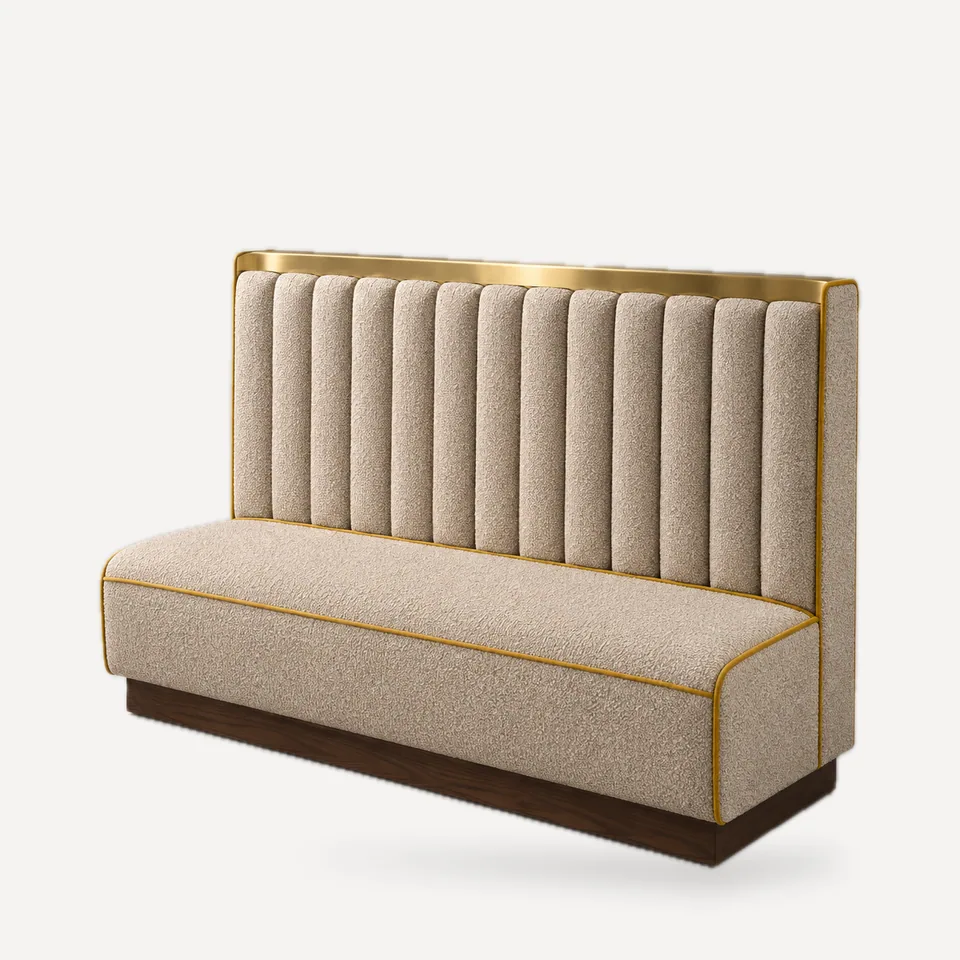
Below is the structure we recommend, shown with a worked example for a channel banquette like our SB-101 Channel High-Back Banquette.
| Field | Example entry |
|---|---|
| Item code | SE-04 |
| Description | Wall banquette, high back, vertical channels, metal top cap |
| Location | Main dining, wall C, gridlines 3-7 |
| Quantity | 1 run, overall 31 ft 6 in (9.60 m), sections per shop drawing |
| Dimensions | Seat height 18 in (457 mm) compressed; seat depth 22 in (559 mm); overall height 47 in (1194 mm) AFF |
| Back | Vertical channels, nominal 4.75 in (120 mm), whole channels per section |
| Seat | Loose-look fixed cushion, HR foam over ply deck |
| Frame | Kiln-dried hardwood and engineered ply, glued and screwed, corner-blocked |
| Base | Recessed plinth, 3 in (75 mm) toe recess, finish WD-02 |
| Cover | Seat and back UF-03 (COM, railroaded); welt WT-01 |
| Trim | Top cap MT-01, continuous where access allows |
| Fixing | Wall cleat to blocking by GC; floor levelers |
| Flammability | Foam and cover combination to meet CAL TB 117-2013; test reports to be submitted where available |
| COM quantity | Per approved shop drawing |
| Submittals | Shop drawings; finish samples WD-02, MT-01; pre-production sample section |
| Packing and labelling | Export packed; each section labelled with item code, section number and location |
Write performance-based requirements where you can ("seat height 18 in compressed") and prescriptive requirements only where they matter ("kiln-dried hardwood frame"). Prescribing a foam brand, for example, limits bidders without improving the result; prescribing density, resilience and flammability performance does the job.
How should you write dimensions?
- State whether each dimension is nominal or critical. Critical dimensions (seat height, overall length to fit a wall) should carry a tolerance.
- Give heights as above finished floor (AFF).
- Use one unit system as primary and show the other in brackets if the project is international.
- For built-in items, write "verify on site" and require a post-finishes survey before shop drawings are approved.
Performance requirements to include
Seating specifications should name the performance standards for the destination market, not generic "commercial grade" language. Examples - confirm the applicable requirement with your fire consultant or authority having jurisdiction:
| Requirement | US example | UK/EU example |
|---|---|---|
| Upholstery flammability | CAL TB 117-2013 (smolder) | BS 5852 ignition sources per BS 7176 hazard level (UK); EN 1021-1/-2 (EU) |
| Fabric abrasion | ASTM D4157 (Wyzenbeek) double rubs | Martindale, ASTM D4966 or ISO 12947-2 cycles |
| Seating strength and durability | ANSI/BIFMA X5.4 for lounge and public seating where referenced | EN 16139 for non-domestic seating; EN 1728 test methods |
| Cleanability | Cleaning code (W, S, W/S, X) | Manufacturer's care code |
Our guide to contract upholstery fabric performance explains these tests in more detail.
Submittals and approvals
Set out what you need to see before production and in what order:
- Shop drawings (plan, elevation, sections, details, COM quantities)
- Finish samples for every wood, metal and laminate code
- COM/COL confirmation of receipt and inspection at the factory
- Pre-production sample or mock-up for key items, approved as the reference standard
- Test reports or data sheets for flammability where required
- Packing and labelling scheme and delivery schedule
Common mistakes
- Describing materials on item sheets instead of referencing codes, so a fabric change leaves conflicting descriptions.
- "Or equal" with no performance criteria, inviting substitutes that cannot be evaluated.
- No direction on COM, which leaves yardage and seams to chance.
- Seat height without a definition, so compressed and uncompressed values are confused.
- Missing responsibility for blocking, services and installation on built-in banquettes.
- Flammability stated as "to code", which tells a manufacturer nothing about which test to meet.
- No reference standard: without an approved sample, disputes about quality have no benchmark.
Checklist before issuing the seating package
- Each item has a unique code used consistently on plans, schedules and sheets
- Every visible material references a finish code
- COM/COL direction, repeat and quantity source are stated
- Critical dimensions have tolerances and AFF references
- Performance standards named for the destination market
- Submittals listed with approval sequence
- Packing, labelling and delivery requirements stated
- Responsibility split (supply, install, blocking, services) defined for built-ins
For seating families that share profiles across chairs and banquettes, see our COM/COL chairs, which are drawn to align with the banquette backs.
FAQ
Should custom banquettes be in the FF&E schedule or the construction documents?
Either can work. If the banquette is fixed to the building and needs blocking, services or guards, many teams include it in the construction documents so it is coordinated with the contractor. If the owner purchases seating directly, it stays on the FF&E schedule with clear interfaces to the contractor.
How detailed should an FF&E item sheet be for custom seating?
Detailed enough that two manufacturers would price the same thing: dimensions, construction, materials by code, performance requirements and submittals. Leave detailing of joints and fixings to the shop drawing, but require it.
Can we specify COM and still allow the manufacturer to source fabric?
Yes. List the fabric code with the mill and pattern, and state whether it is COM or to be supplied by the manufacturer. Some projects let the manufacturer source to avoid shipping fabric internationally; the specification should say who is responsible.
What is a reference standard sample?
An approved physical sample - a chair, a banquette section or a finish panel - that defines acceptable quality for the order. Production is checked against it, which makes approvals objective.
Send your drawings package or FF&E schedule and we will return a scope review, quote and first shop drawings. Partial packages are fine; tell us what is still in design.
Request a quote